In the 1800s there was no Social Security safety net, no food shelves, no unions. It was the days of poorfarms and orphanages and catastrophic illnesses, alcoholism, abandonment. Government was no help: 2025’s Fédération Internationale de Football Association (FIFA) World Cup, of the 40 participating nations, only the US hasn’t a universal health care system. Those less fortunate are still considered at fault by the federal government.
In the 1800s immigrant communities, benevolent societies and religious organization filled the gap. This survey is drawn from the Origin Story (2025) of our city. The focus is on healthcare by citizen helpers.
In 1851 four Sisters of St. Joseph of Carondelet opened St. Joseph’s Academy, a boarding and day school and in 1853 staffed a temporary log cabin hospital on Bench Street (Second Street, a “shelf” in the bluff downtown) second) in the midst of a cholera epidemic. In 1854, they opened St. Joseph’s Hospital in the first stone building in Saint Paul. It had private rooms, balconies, a chapel, a laundry, an assembly room and a smoking room. The hospital closed in 2022 and is now St. Mary’s Health Clinics staffed by volunteers for the low-income and uninsured.
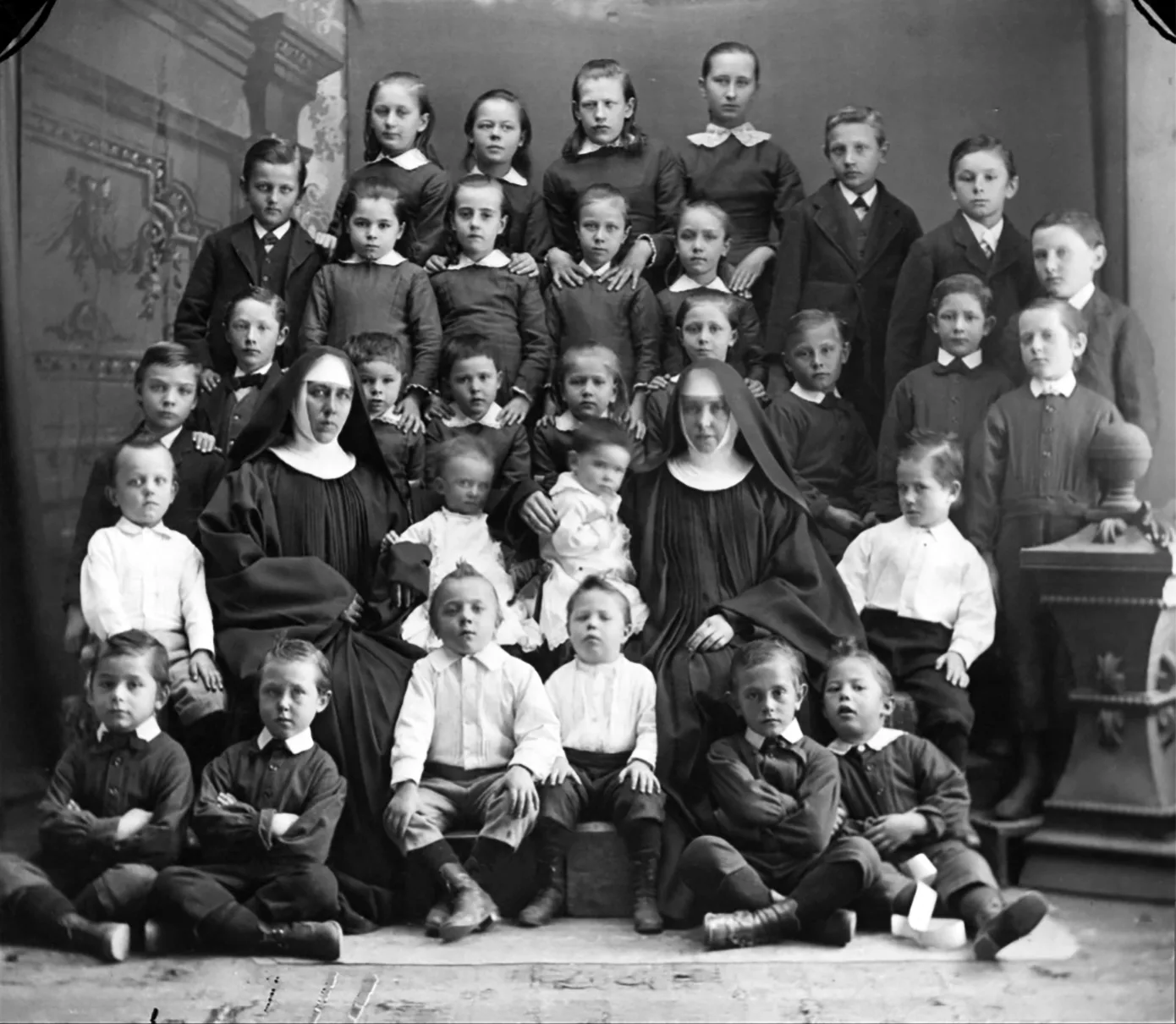
St. Joseph’s German Catholic Orphan Society was formed in 1869, serving youth left parentless by the dangers of pioneer life, the Civil War and pandemic. In 1877, sisters of St. Gertrude’s Benedictine Convent in Shakopee cared for orphan children in a facility at Ninth and Robert Streets that grew to 90. They moved to Ninth Street between Exchange and Fort Street near Assumption School.
The Sisters of the Good Shepherd purchased 90 Wilkin Street in 1869 and five years later had 100 former prostitutes under their care. As railroads blasted below the bluff for rails, in 1875 the Sisters sued the Saint Paul, Sioux City Railroad Company, won and sold part of the property. The rest went to the Little Sisters of the Poor for their Home for the Aged in 1884. In 1974 they opened a dental clinic as part of Helping Hand.
From 1908-1916, nearby on Wilkin was the Jewish Home for the Aged for eight “inmates”—the term then used for residents. It was the predecessor for Shalom Home on Seventh Street.
St. Luke’s Hospital was organized in 1855 as the Christ Church Orphans’ Home and Hospital and was managed by a “Board of Lady Managers.” It closed in 1866 and reorganized as the Church Hospital and Orphans’ Home. It had three successive locations, finally at Smith Avenue and Sherman Street. In 1877, the name was changed to St. Luke’s. In 1972 Saint Luke’s and Charles T. Miller Hospital consolidated to form United Hospital.
In the 1850s the Salvation Army was founded to preach the gospel and meet human needs without discrimination. The Sal came to Saint Paul in 1888 and West Seventh in 1958.
The Protestant Orphan Asylum purchased 698 Stewart in 1872, but in 1885 moved to larger facilities. The home and its 25 acres showcased spectacular views of the Mississippi River. From the late 1890’s to 1930, the Blue Ribbon (men’s) Club maintained the residence. The “ribbon” was worn by those who pledged abstinence from alcohol.
Children’s Hospital was founded in 1924 at 263 Smith Avenue “to fit the child instead of molding a child to fit the hospital”. Children’s moved from Smith (with 16 beds) to a new, much larger, building at 311 Pleasant Avenue that was converted to condominiums in 1979 when the hospital moved to its current location at Smith and Grand Avenue.
In 1931 Lindsay School for Crippled Children was located at Pleasant and Sherman. The school’s capacity was 100 children though two classrooms were added. Lindsay School was torn down in 1978 and replaced with new programs at Bridgeview and Como Park Elementary.
The United Ancient Order of Druids (UAOD), a fraternal organization, was founded in England in 1833. Its motto is United to Assist. Its first Minnesota Grove was organized in 1856 at Unity Central Hall, Seventh and St. Peter. Of six Saint Paul Groves, four were English and two German. Druids advocated “unity, peace and concord” and based their secrets upon charitable and benevolent principles. Their philosophical foundation was universality and non-denominational and practical duties to “attend the sick and dying, administer consolation to distressed and suffering, and provide for wants for those in need.”
The first lodge of the Independent Order of Odd Fellows in Minnesota was chartered in Stillwater in 1849. The Capital City (Union) Lodge #048 was instituted January 21, 1875 at 156 West 9th Street with 14 members. From 1902 to 1946 the top floor of the Sauerwein Building, 265 West Seventh, was home to the expansive lodge. The Order recognized no sect or creed, neither political or sectarian or religious; their laws commended (us) to visit the sick, care for and help the distressed; attend to the widows and orphans and bury the dead.”
From 1914 to 1974 the Amherst H. Wilder Charity opened the city’s first public bathing house at 319 Eagle Street in the Seven Corners neighborhood in Saint Paul. In her will, Fanny Wilder specifically asked that money from her estate be used to provide the residents of Saint Paul with a place where anyone could swim or bathe. From 1930 to 1976, the Wilder Day Nursery Number 2 served children ages one to five at 73 Leech Street.
Although 680 Stewart Avenue was built in 1885, and was the site of a neighborhood beer garden, the river bluff site has emerged to become the Hazelden Betty Ford complex in treating addiction. In 1953 it opened a halfway house at 680 Stewart for men for a sober-living residence. In 1976 they began outpatient services in partnership with a local hospital.
You can find a copy of “The Origin Story of Fort Road/West Seventh Street, the Township/City of Saint Paul, the Territory/State of Minnesota: Glacial Age Forward” at your local library, or order up a copy of your own at fortroadfed.org. Learn more about the book and find Joe’s upcoming conversations about the history of West 7th at josfland.com.



Leave a Reply