
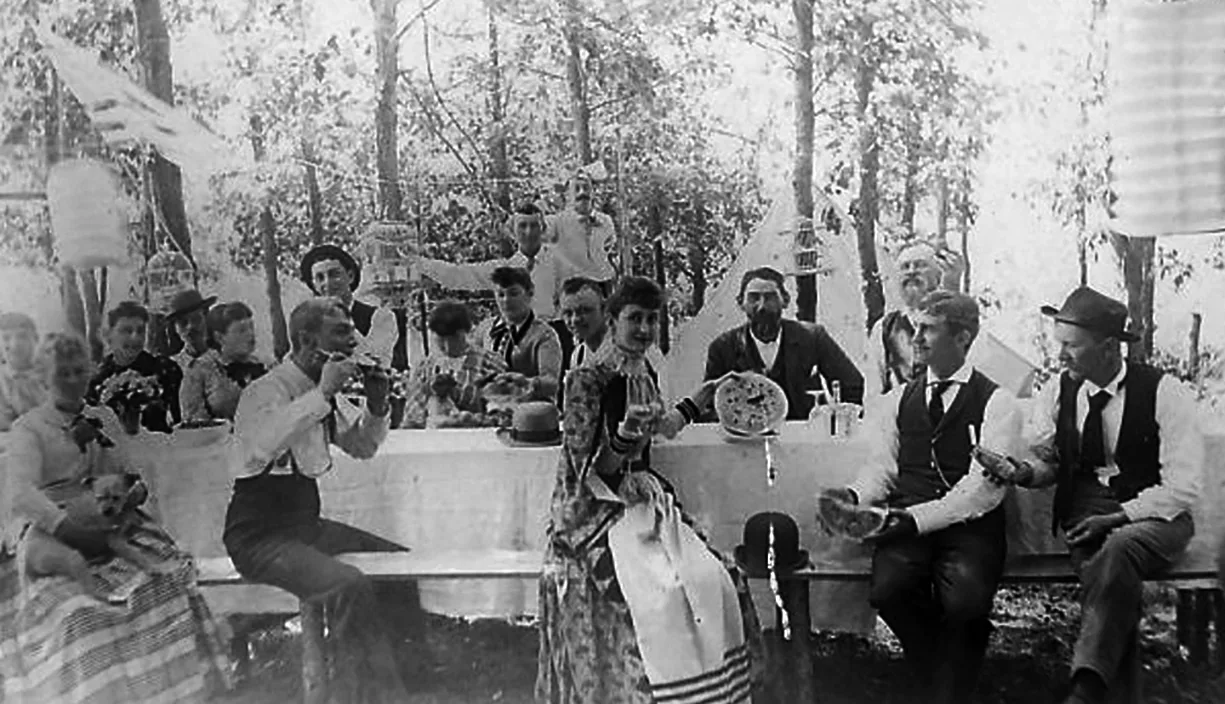
Back in early St. Paul “Tied Bars” served beer exclusively from one of its local German brewers. In the 1870s local Germans took out 121 of the 187 liquor licenses: In the late 1800s had twelve St. Paul breweries operating at one time. So there was tavern for every taste, and a thirst for each beer. In 1887, Minnesota, in spite of being the twentieth ranked state in the nation in terms of population, ranked fifth in terms of beer production, with 112 different breweries operating in the state.
With its large concentration of German immigrants, the related labor force included brewmasters, dreymen who delivered locally, livery yards and stables, wagon makers, coopers (barrel and cask manufacture), bar and restaurant owners, even cave diggers and ice harvesters, architects and bankers. Midwest farmers provided hops and barley.
1848-1958: Yoerg’s Cave Aged Brewery
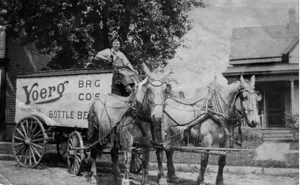
Bavarian Anthony Yoerg (1816-1896), was the first German commercial brewer. In 1837, he emigrated to the United States, ran a butcher shop on the West Side, then opened a small brewery at Seven Corners. His was a hearty, Bavarian-style beer. In 1871 he returned to the West Side and built a great stone brewery at the base of Ohio Street hill that featured a mile of underground cooling caves. In 1891 production was thirty-five thousand barrels. The Bavarian staff utilized a steam process, brewed at warm temperatures using lager yeasts. Yoerg married Governor Alexander Ramsey’s nanny (Elovina Seitzsinger) and had seven children. The youngest, Louis, succeeded his father; the last two sons died 1950 and 1952, and in 1958 a fire erased the landmark.
1855-1901: Troyer’s Cave Brewery
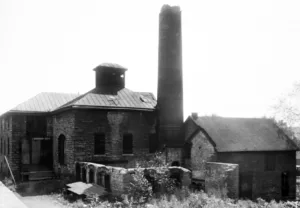
Austrian Dominick Troyer (1820-1889) built a small 1-1/2-story stone and wood facility near Eagle and Exchange Streets near Yoerg’s. In 1860 he sold it to William Funk and Ullich Schweitzer, fellow Germans. In 1865 Funk sold City Brewery to Frederick Emmert (1831-1889). By 1878 it became St. Paul’s second-most productive brewery. In 1880 peak production reached 6,000 barrels.
Emmert’s friends included Governor Ramsey; the two were members of the Athenaeum German Hall on Wilkin and Exchange and the Republican Party. When Emmert died, in 1889, his sons, Fred, William and Charles, continued to grow the operation, and in 1890 changed the name to the F. Emmert Brewing Company. They catered to the saloon district, Seven Corners to the Upper Landing. Charles owned the notorious “Bucket of Blood,” 301 Eagle/192 South Washington on the Upper Landing. Police Chief John J. O’Connor’s wife was its reputed madam. In the early Twentieth Century O’Connor instituted the infamous “safe haven” system for notorious criminals. At the turn of the century Emmets was sold to Hamm’s Brewery who used it for storage.
1865-1901 Melchior Funk Brewery
Melchior Funk (1828-1893), an immigrant from Württemberg, started his brewery in 1865 at James and Cascade (Palace) near Stahlmann’s Cave Brewery. Funk’s stood above the Mississippi River alongside sandstone caves and above a deep well. A two-story complex contained the main brewery. Steam-driven machinery powered the company’s engine, boiler, air pump, feed pump, heater, etc. By 1879, the brewery produced over 1,700 barrels of beer yearly; this output made it the sixth-largest brewery in the city.
According to St. Paul Globe in 1880 Funk employed five to six men year-round and used an eight-horse power engine in stone buildings that were heated with wood and illumined by candles. He used a well and Cascade Creek that ran through his brewery for water. A large cellarage in sand rock stored 5-600 tons of ice. After Funk’s death March 6, 1893 his sons John and William continued operations until1901.
1855-1876: Christopher Stahlmann’s Cave Brewery
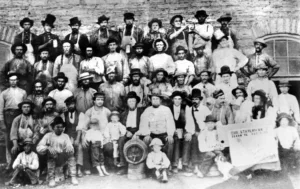
Bavarian Christopher “Christ” Stahlmann emigrated in 1855 and opened his Cave Brewery on July 5, 1855, along Fort Road/West 7th. It became the largest brewery in Minnesota, averaging more than 10,000 barrels of beer per year. His plant consisted of five three-story buildings on sixty lots (valued at $150,000), two large steam engines, three boilers, a variety of small machinery and a work force of forty-seven men.
Stahlmann was prominent politically but died in his home at 855 Fort Street at the height of his career of tuberculosis on December 3, 1883. His funeral was one of the largest in St. Paul. After his death, his two sons, Christopher, Jr. and Bernard, succeeded him but died soon after of the same disease. Without the Stahlmann family, the business went into bankruptcy, eventually sold to the Jacob Schmidt Company.
1870s: Stahlmann’s Horse Stables.
Stahlman’s Horse Stables, across from the Schmidt Brewery, is located at Webster Street at Jefferson. They were built in the 1870s and later used for Schmidt’s storage. The roughly coursed stone is limestone from a local riverbank quarry. Note the second story hay loft. Image 1940 MNHS
871–1904: Frederick and William Banholzer
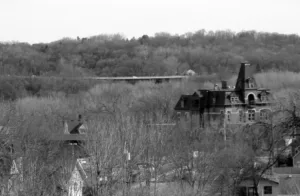
The Banholzers, Frederick (1823-1903) and son William (1849 – 1897), bought the North Mississippi Brewery. By the 1880s William turned a 1,000 into a 12,000 barrel-a-year operation, one of the five most popular brews in the city. The operation included nine buildings, a one-half-mile deep, multi-chambered cave under the river bank at Shepard Road to Butternut street. Its old stone archway at the lower entrance is a lasting reminder.
William died at his mansion at 689 Stewart Ave, and the brewery went out of business in 1904. His house is now Hazelden Betty Ford Foundation’s outpatient addiction treatment facility.
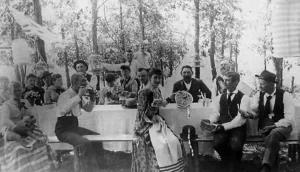
In the 1800s it seemed there were bakeries, shoe stores, grocers, confectioners and taverns not only along its arteries, but also on residential street corners of our neighborhoods. Bandhozers and Shades beer gardens were also cultural magnets for parades, dancing, singing, Turner and Sokol gymnastic demonstrations, even balloon rides along the Mississippi River. It was a different time.
To be continued…
You can find a copy of “The Origin Story of Fort Road/West Seventh Street, the Township/City of Saint Paul, the Territory/State of Minnesota: Glacial Age Forward” at your local library, or order up a copy of your own at fortroadfed.org. Learn more about the book and find Joe’s upcoming conversations about the history of West 7th at josfland.com.






Leave a Reply