
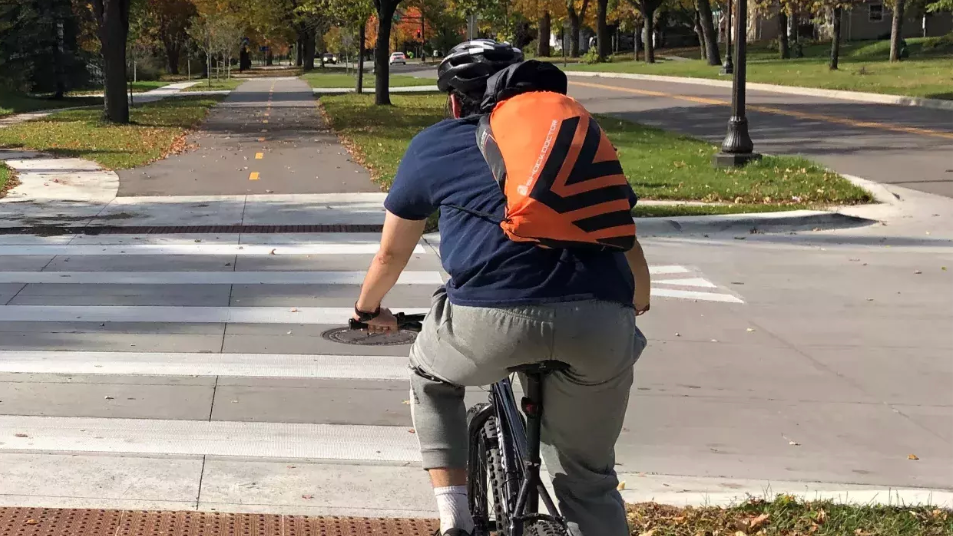
In the next five years, the city will plant 4,000 trees, add at least 25 more miles of bike trails, install air quality monitors and complete a host of other projects aimed at making the city cleaner and more gentle on the environment. These projects are called for in the city’s Climate Action & Resilience Plan, created in 2019 and updated this summer. The end goal is to eliminate or offset all carbon dioxide released into the atmosphere from city operations by 2030, and citywide by 2050.
One of the top initiatives between now and 2031 is “decarbonizing downtown.” This entails improving energy efficiencies in buildings, decreasing emissions from transportation and other efforts. According to the action plan, city staff expect to reduce a whopping 85% of emissions related to heating through one means alone: capturing waste heat from the Metropolitan Council wastewater treatment facility near Pig’s Eye Lake. Currently, downtown buildings are served by a district heating system that uses heat from the combustion of biomass and natural gas. A lofty $250 million is needed to advance the work, and the city and its project partners, including District Energy St. Paul, Xcel Energy, Met Council and Minnesota Department of Commerce, plan to draw upon bonding and state and federal grants for funding.
The City’s latest project in its quest for “carbon neutrality” is installing a $16 million geothermal energy system at Como Zoo & Conservatory, the city’s largest energy-consuming facility. Energy costs there have exceeded $1 million annually but the new system, expected to be completed this summer, will make it carbon neutral.
Ordinance change
The city is also updating its sustainable building ordinance that requires new and renovated buildings that receive more than $200,000 in financial support from the City to receive a Green Building Standards certification, such as LEED (Leadership in Energy and Environmental Design). The update will require even higher levels of energy-saving standards than previously required. Notably, the handful of downtown buildings that have been acquired by the St. Paul Development Corporation, a subsidiary of the St. Paul Downtown Alliance, are subject to the ordinance. Likewise, a 112-acre redevelopment located on the former Hillcrest Golf course on the East Side, dubbed the Heights, must get certifications for all its buildings. The St. Paul Port Authority is the lead developer and aims for the project to be one of the first net zero (operates entirely on renewable energy, with zero carbon or other greenhouse gas emissions) developments in the country. The state’s largest networked geothermal heating and cooling district system is also being installed at the site to serve both industrial and residential buildings, including 140 all-electric “ultra energy efficient” homes.
Top projects
High priority initiatives laid out in the 5-year climate action plan include:
- Growing the City’s climate fund
- Creating a citywide thermal energy plan by 2028
- Developing a policy requiring any data centers in the city to be located where waste heat can be recovered and utilized in neighboring buildings
- Completing the Capital City Bikeway downtown and adding at least 25 more miles of bike lanes (to total 254 bikeway miles in the city)
- Installing renewable energy sources at 10 priority buildings identified in the city’s 2025 Municipal Buildings Decarbonization Plan
- Completing a municipal fleet decarbonization plan
- Identifying communities vulnerable to poor air quality and installing air quality monitors there
- Converting turf and pavement to drought-tolerant native plants and educating residents how to do the same
- Creating a center where people can drop off or pick up used furniture
- Planting 4,000 trees per year to help decrease “urban heat islands” and restore tree canopy lost to emerald ash borer infestation.
In St. Paul, about 67% of emissions come from building energy use – roughly 40% are from electricity and 60% from natural gas. Transportation makes up the next largest share of emissions at 32%. It’s estimated that city-owned buildings and vehicles create approximately 2% of total emissions. Additionally, it should be noted that reaching carbon neutrality doesn’t mean there will be zero carbon emissions but that 100% of emissions will be offset by renewable energy sources. However, in its efforts to reach carbon neutrality the city expects to reduce carbon emissions by 63% (from 2018) citywide by 2030. To view the updated plan, visit stpaul.gov/departments/mayors-office/climate-action.
Past success
Citywide, carbon emissions have decreased by 25% since 2019, according to city documents. The Climate Action Plan addresses four areas, and strides have been made in each:
- Sustainable transportation
- Offering more transit options so there is less dependence on single-person vehicles. Recent projects include the construction of the Gold Line Bus Rapid Transit, B Line and G Line.
- Creating one of the country’s largest municipally owned electric car sharing networks. Evie cars are powered by 100% renewable energy and 170 are available for public use through subscription plans. There are more than 280 charging stations across the Twin Cities.
- Transitioning city fleet vehicles to electric vehicles and hybrids. The city purchased the state’s first all-electric fire engine in 2024 and added a second electric fire engine in 2025.
- Eliminating minimum parking requirements and single-family zoning to reduce overbuilding of parking spaces and increase residential density.
- Energy use in buildings
- Simply requiring large commercial and multi-family buildings to benchmark and track their energy and water use has brought an 11% decrease in energy use in those buildings.
- Reducing solid waste
- The city adopted a To-Go Packaging ordinance that requires take-out food and beverages to be packaged in environmentally friendly containers that can be composted or recycled.
- Partnering with a local business to recycle mattresses that would have instead been incinerated. It’s estimated that more than 9,000 mattresses have been recycled since 2024.
- The City has installed 80 solar-powered garbage cans downtown capable of holding more trash. They also include recycling bins, where previously there had been none. According to St. Paul Garbage and Recycling Program Administrator Sarah Haas, about 40% of the material picked up is now recycling.
- Promoting drop-off composting sites as well as Ramsey County’s seven 24/7 food scrap (organics) collection sites in St. Paul
- Enhancing urban resilience
- Removing all ash trees infected by emerald ash borer from the public rights-of-way.
- Creating an online Climate Dashboard (climateaction.stpaul.gov/actions) to provide climate action plan updates to the community and beginning an annual climate forum that brings together community members to discuss progress and gather support for climate initiatives.
Feeling the heat
According to the updated climate action plan, the global average temperature has risen by nearly 2.7 degrees Fahrenheit in the past 150 years, a result of extracting, processing and burning fossil fuels (coal, oil, and natural gas) for travel, heating, electricity, and industrial processes, as well as agricultural practices and deforestation. Globally, 2024 was the warmest year on record, according to the World Meteorological Organization. Locally, in 2023, St. Paul saw a record number of days over 90° (33 days, compared to an average of 13) and the latest date where the temperature exceeded 90°F in October. That summer, St. Paul was also impacted by a record-setting number of days with poor air quality (52 days), largely due to smoke from Canadian wildfires. Above average temperatures continued into the 2023-2024 winter, which saw little precipitation and consistently warm temperatures, earning the title of the “Lost Winter” by Minnesota Department of Natural Resources. Heavy rain events in late spring and early summer of 2024 led to river flooding, affecting Lowertown and surrounding areas where water covered roads and damaged buildings.
Climate tracking
The University of Minnesota has created an interactive online tool, CliMAT, that provides localized climate projections for Minnesota communities. Using the tool, the scenarios include the following projections by 2050:
- Warmer summers: Average summer high temperatures are expected to increase 5.5 degrees to 87 degrees; and the annual number of days that exceed 90 degrees is projected to increase to 37 days, from the 1995-2014 average of 13 days.
- Warmer winters: The daily average high temperature is projected to be 24.2 degrees, 5.5 degrees above the historical average. The daily average low temperature is projected to be 17.5 degrees, 6.4 degrees above the historical average.
- Precipitation patterns: Annual maximum precipitation for a single day in Ramsey County is projected to be 3.6 inches. Precipitation is not expected to change uniformly throughout the year, rather winter and spring precipitation are projected to increase, while summer precipitation is expected to decrease, leading to wider extremes of wet and dry periods.
Tree preservation
In related news, the St. Paul City Council recently approved a tree preservation ordinance that takes effect in October. It’s designed to prevent less trees from being cut down for city projects, protect trees located near active construction areas, and place higher standards and accountability on tree replacements when removals are unavoidable. The 18-month effort to bring the ordinance to fruition was initiated by Council President Rebecca Noecker, in response to community feedback.
“Trees are essential city infrastructure,” said Noecker in a statement. “They provide shade, improve air quality, support our climate resilience goals, and contribute to the character and livability of our neighborhoods…. This ordinance is the result of a tremendous amount of collaboration, discussion, and hard work. We heard from residents who wanted stronger protections for our urban forest, while also recognizing that the city must continue to make critical investments in streets, utilities, parks and other infrastructure. This policy creates a clear and accountable process for doing both.”
This story was originally published in the St. Paul Voice. The newspaper is part of MNcomm, as is the Community Reporter and seven others that reach 400,000 residents in St. Paul and Minneapolis at their front doors.





Leave a Reply