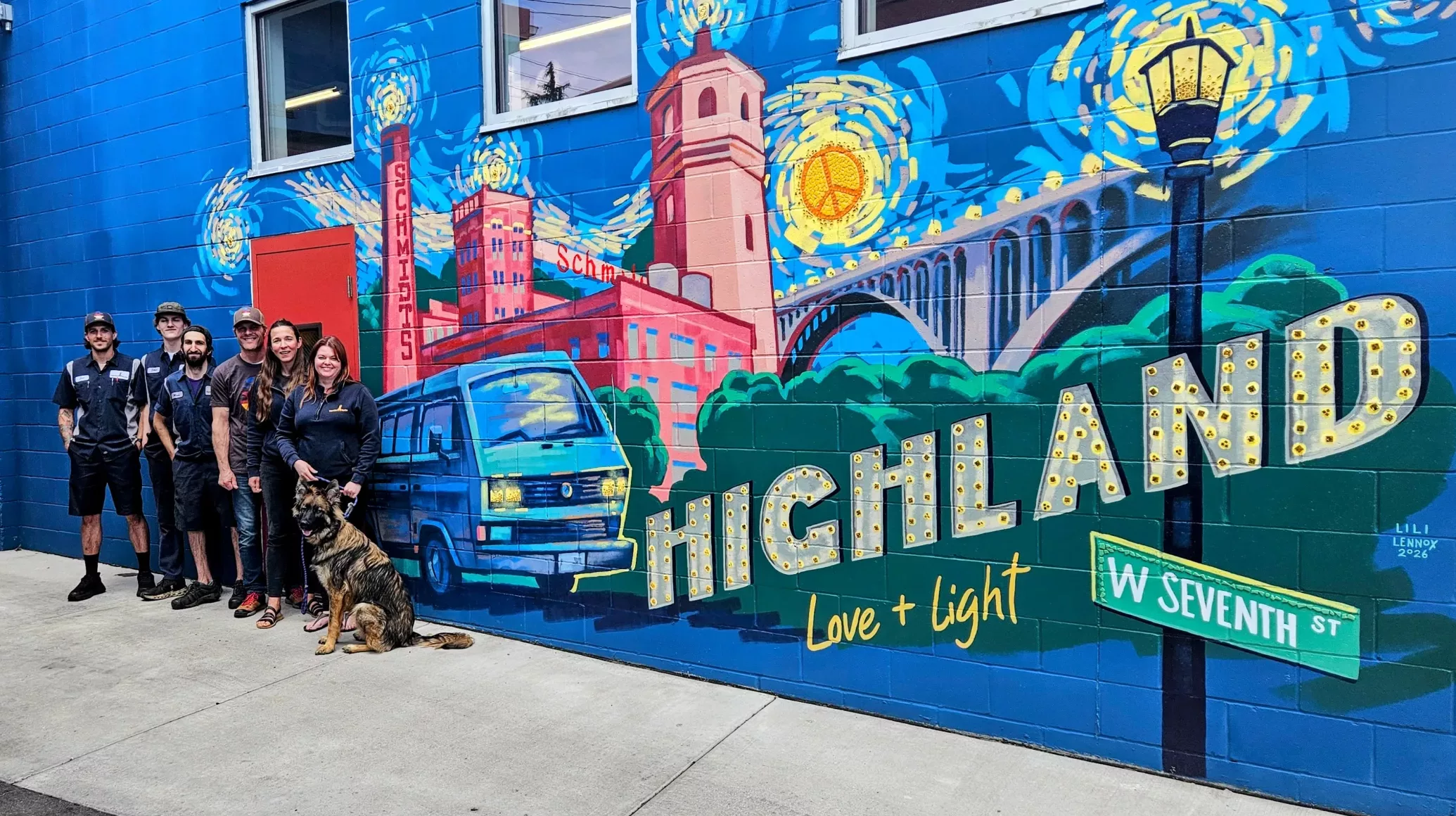
Drivers entering St. Paul on West 7th Street are now greeted by a colorful mural featuring some of the city’s most recognizable landmarks.
Painted on the side of VanGo Auto near the western gateway to the city, the artwork incorporates the Schmidt Brewery complex, the Highland water tower, the High Bridge and even the iconic Highland Theater sign. Elements of Vincent van Gogh’s “Starry Night” swirl through the design — a fitting touch for a business named VanGo Auto.
“We never thought of the artist when we were picking a name, but everyone else thinks of him,” said Crystal Frank-Shannon, who owns the business with her husband, Jordan Frank-Shannon.
The mural is one of dozens of projects funded through St. Paul’s Commercial Corridor Program, a city initiative that is quietly reshaping business districts across southwest St. Paul.
Created as part of the city’s 2025 budget, the program dedicated $1.4 million in Economic Development STAR funds to 18 commercial corridors throughout the city. Rather than directing projects from City Hall, the city allocated funding to District Councils and business organizations already working within those neighborhoods.
The result has been a series of locally driven investments that reflect the unique character and needs of each corridor.
St. Paul’s West End and its neighbors include five of the 18 designated commercial corridors, the east and west ends of West 7th, Highland Village (which includes portions of Snelling, Ford and Cleveland) and the eastern Grand Avenue and the Grand and Snelling node.
For VanGo Auto, the funding created an opportunity that otherwise would not have existed.
“As the first business you see coming into St. Paul, we are always trying to beautify our property,” Crystal Frank-Shannon said.
Jordan Frank-Shannon said the business would not have been able to complete the project without the grant funding.
“It’s a nice little welcome to this part of St. Paul,” he said.
The mural serves as a visible example of how the Highland District Council has approached the Commercial Corridor Program.
The council administers funding for both the western section of West 7th Street, from Homer Street to Wheeler Street, and the Highland commercial district centered around Ford Parkway, Snelling Avenue and Cleveland Avenue.
Rather than focusing primarily on large events, the organization has directed funding toward projects that improve the appearance and visibility of individual businesses while strengthening the broader corridor.
Among the first grant recipients were Joan’s in the Park, Sew Inviting, Dancers Studio and VanGo Auto. Projects included storefront improvements, awnings, window displays, murals and marketing partnerships.
The investments are designed to create a stronger first impression for visitors while helping existing businesses remain competitive.
A different strategy has emerged on the eastern portion of West 7th Street.
The West 7th/Fort Road Federation has used Commercial Corridor dollars to launch arts-focused programs intended to strengthen the neighborhood’s identity and attract visitors.
Its VIBE program — Vibrant Initiatives for Businesses and Events Activation — funded murals, public art, sculptures, photography projects and community events throughout the corridor between downtown and Homer Street.
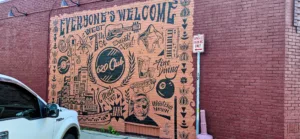
Recipients included a mural at the historic 620 Club, a sculpture and trellis installation at Bad Weather Brewing Company, community arts projects, neighborhood history initiatives and small-scale events designed to bring people onto the corridor.
The organization later expanded those efforts through a dedicated mural grant program supporting new public art projects along West 7th.
While West 7th’s investments have often focused on public art and placemaking, Grand Avenue organizations have taken yet another approach.
The avenue has faced years of economic pressure from construction projects, changing retail patterns and rising operating costs. Leaders there saw Commercial Corridor funding as an opportunity to stabilize existing programming while continuing investments that help make Grand Avenue a destination.
Kim O’Brien, executive director of the Grand Avenue Business Association, said the organization used the funding to support both events and beautification efforts.
“GABA has used the Commercial Corridor Organization Assistance Program to further our mission to support Grand Avenue business success and promote our community as a unique destination experience,” O’Brien said.
The association’s board prioritized maintaining long-standing community traditions, particularly Grand Old Day.
Grand Old Day has lost money for the business association during the past three years, O’Brien said. Commercial Corridor funding has allowed the organization to continue the event without exposing the organization to financial risks it could not absorb on its own.
“This fund enables us to do so without putting the business association at financial risk that it could not recover from,” O’Brien said.
The funding has also supported initiatives designed to encourage people to spend more time along the corridor.
Pianos, live music, flower baskets and holiday decorations have all received support through the program.
“These are all initiatives that support the broader Grand Avenue business community,” O’Brien said.
On the western section of Grand Avenue, the Macalester-Groveland Community Council has emphasized direct business support to mitigate construction impacts, with about half the grants supporting operational expenses during the Grand Avenue reconstruction last summer, and corridor improvements.
Victoria Miller, who manages the program for the MGCC, said the program has fundamentally changed how district councils can work with local businesses.
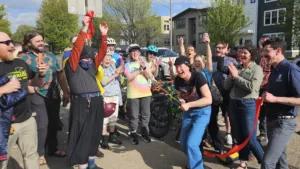
“Being a financial partner to these businesses is something that, without the commercial corridor program grant, would have never been possible for a district council,” Miller said.
Historically, district councils have served as advocates, conveners and neighborhood planners. The Commercial Corridor Program created an opportunity to become direct economic development partners, strengthening relationships between neighborhood organizations and business owners.
“At the end of the day, we can provide meetings and we can change some things around from a city perspective,” Miller said. “But what the businesses need is money.”
“I’ve learned so much about the businesses and know the owners because of this grant,” she added.
That relationship-building becomes particularly valuable when businesses face challenges such as construction projects, infrastructure work or other disruptions.
“When there is going to be something difficult … we have a little bit of a relational equity built up with them,” Miller said.
Although the projects vary widely, from murals and storefront improvements to festivals and flower baskets, they all stem from the same underlying idea: local organizations are often best positioned to determine what their business districts need.
The city structured the Commercial Corridor Program around that principle, giving neighborhood organizations broad flexibility while requiring that projects demonstrate measurable economic development outcomes.
A year and a half after the program’s creation, the results are increasingly visible throughout St. Paul.
On Grand Avenue, they can be seen in community events, live music and streetscape improvements. With the Fort Road Federation, they appear in murals and public art projects. In Highland and western West 7th, they take shape through storefront upgrades and investments like the VanGo mural greeting visitors entering the city.
Different neighborhoods have chosen different paths, but all are working toward the same goal: strengthening the commercial corridors that serve as the economic and social heart of their communities.
Editor’s Note: Community Reporter has received Commercial Corridor Program funding through partnerships with organizations referenced in this story, including for marketing and community engagement projects. No Commercial Corridor Program funds were used to report, write or produce this article, and participating organizations had no editorial control over its content.


Leave a Reply