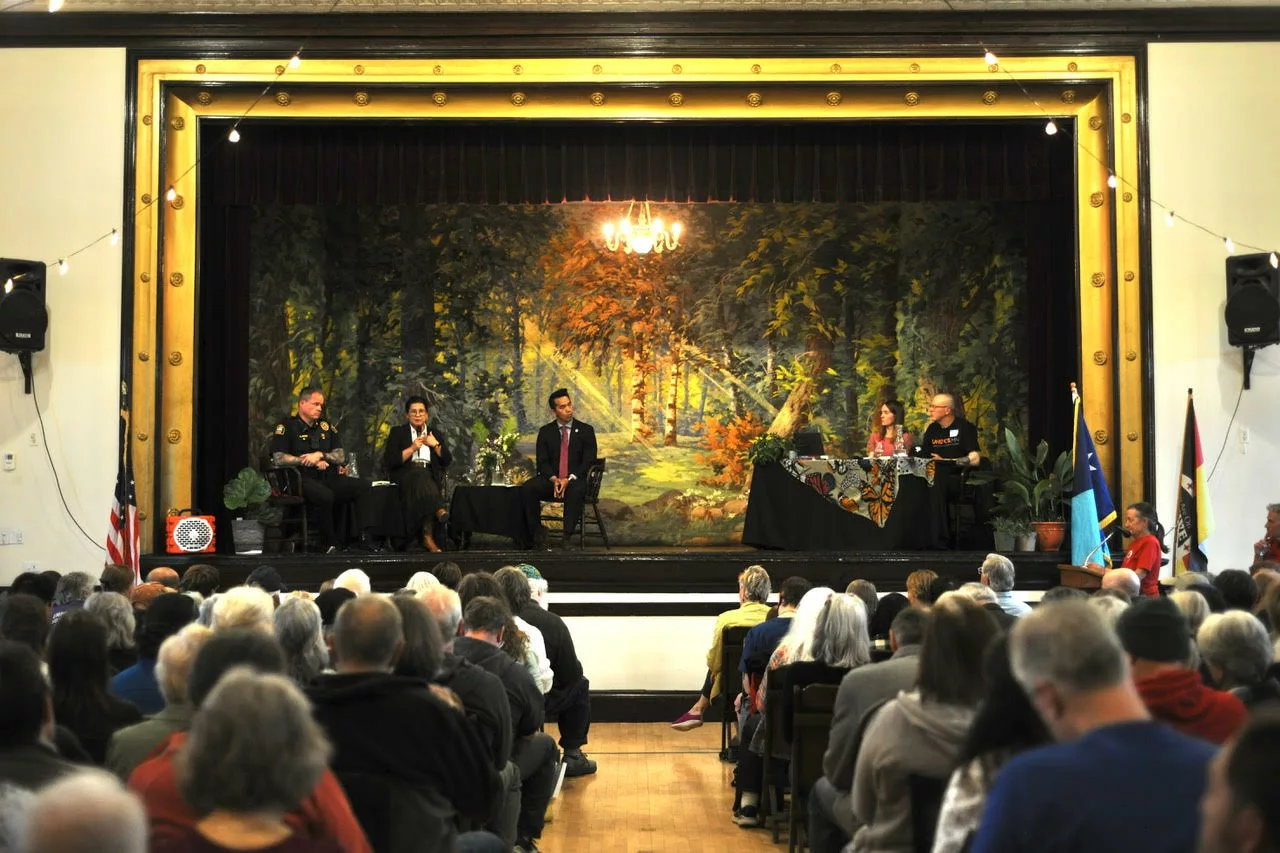
More than 400 community members packed C.S.P.S. Hall on May 19 for an opportunity to talk to three of St. Paul’s highest ranking public officials about election integrity and safety this November.
The town hall was organized by W7th Gardeners of Resistance, a local chapter of Indivisible; a grassroots organization dedicated to civic involvement and progressive policies. Organizer Emily Goodhue hoped the meeting would foster positive discourse leaders.
“One of our main goals is wanting to create more of a coalition with our leaders,” Goodhue said. “Tonight is trying to share feedback on what went wrong when ICE was here.”
On flash cards passed to organizers, some attendees wrote that they fear federal presence and intimidation during upcoming midterm elections.
“I’m concerned about poll safety when it’s time to vote, especially for people of color,” St. Paul resident Patty Torres said, later questioning police involvement with immigration enforcement operations in St. Paul. “Since they’ve now cooperated with ICE, how do they plan on balancing that with protecting citizens of St. Paul?”
St. Paul Mayor Kaohly Her, St. Paul Police Chief Axel Henry, and Assistant Ramsey County Attorney Hao Nguyen tried to address those concerns at the two-hour event.
The crowd’s distrust of law enforcement was evident, with SPPD’s response to the Rose Avenue ICE raid in November, where they used chemicals and less-lethal munitions on protestors, still fresh. This incident occurred alongside diplomacy with federal agencies to de-escalate situations like the Bro-Tex raid November 14, according to Henry.
“They wanted to arrest protestors and I convinced [DHS] to leave. I thought I was going to be able to do the same thing on Rose and unfortunately that wasn’t the case,” Henry said. “Looking back on it, I would’ve personally gone back to that scene and literally waded right into that and just made a bigger stink about that.”
The SPPD is still under an active investigation for their role in the November incident to determine whether they violated the City’s separation agreement in assisting federal immigration activities.
Amidst occasional boos and interjections from the crowd, Her, Henry and Nguyen received applause for explanations of their work behind the scenes during Operation Metro Surge.
“Chief Henry and I did sit down with Monarca and we did sit down with the Immigrant Defense Network,” Her said. “And we did say to them, we want there to be a community response in the future.”
She went on to say that community involvement is so important because local police were in a no-win situation responding during the highly charged Operation Metro Surge enforcement activities.
“It’s going to look like we are coordinating with ICE when we’re called to be at that scene,” Her said.
Though many pre-written questions revolved around St. Paul’s response to Operation Metro Surge, the evening was framed around maintaining local integrity in upcoming midterm elections, fear from continuing immigration enforcement operations and how local law enforcement, especially SPPD, would be able to maintain public safety at polling sites.
“SPPD may again find yourself in a position where you have to make a choice,” one crowd member said to Henry. “To avoid any actions that may upset our government, or to step up and protect us, our community.”
But it isn’t as simple as choosing between one or the other, Henry said, receiving boos from some crowd members.
Her said she’s working with Secretary of State Steve Simon on election planning, but since elections are administered by Ramsey County, the City of St. Paul has little jurisdiction over elections. She said that suggestions can be sent to her office and that public discourse is welcome.
Her said, for people feeling unsafe, Minnesotans can place their vote by mail as an alternative to visiting polling sites.
Both federal and Minnesota laws limit law enforcement presence at polling sites, putting local leaders at the drawing board for legal solutions should federal agencies become involved in elections. Police can only be present at polling sites should a 911 call be received and discussed with the location’s election judge.
That said, Her was sympathetic to the community’s concerns.
“None of us believe that this federal government isn’t going to continue to violate our constitutional rights,” Her said. “That this president is done with what he has done to us as a city or as a state.”






Leave a Reply