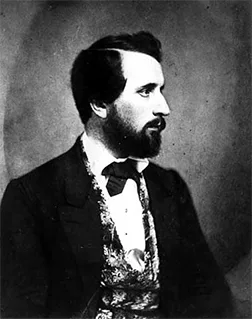
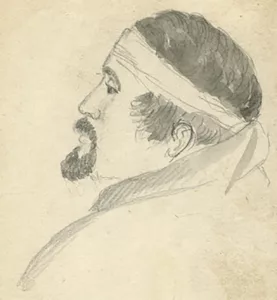
Robert Ormsby Sweeny (1830-1902) arrived in St. Paul in 1852 as near the first documented Quaker to the territory. His mother Rachel Ormsby (1797-1841) was from a prominent Philadelphia Quaker family. His father, Frederick was an Irish immigrant who died in 1845 during the Mexican War. As a youth Robert supported himself as a clerk in a hotel and wholesale silk house as well as pharmacy where he learned the profession.
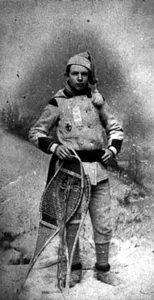
Credit: MNHS
The Philadelphia College of Pharmacy was founded in 1821 as America’s First College of Pharmacy. It was established by 68 Philadelphia apothecaries; many were members of the Religious Society of Friends (Quakers). While not an official “Quaker school” by church affiliation, every president of the college between 1821 and 1900 was a Quaker.
In 1852 Sweeny arrived in St. Paul and worked with W. S. Potts, a pioneer druggist. Sweeny opened his own apothecary shop on Third Street (now Kellogg Boulevard) at Bridge Square at St. Paul’s first bridge. He spoke both Dakota and Ojibwe and described himself as “Proprietor and Manafacturer [sic] of Sweeny’s Wild Cherry Cough Syrup, Cholera Mixture. Stewart’s Cough Syrup. Corn and Wart Cure. Dysmenorrhoea Drops. Neuralgiafuge. Toothache Drops. Indelible Ink. Pink of Pink Tooth Powder.”
He was also a prominent Mason of remarkable artistic talents. The 1856-57 city directory listed him as a “designer,” and the 1857 census as an “artist.” In 1858 the legislature approved his design of the Minnesota state seal, but it was rejected by Governor Henry Sibley since it portrayed harmony between Native Americans and settlers.
Sweeny co-drafted legislation for standards for pharmacists and co-founded the Minnesota Pharmaceutical Association. In 1870 he was part of a group of citizens who founded the St. Paul Academy of Natural Sciences, a forerunner of the Science Museum of Minnesota. He served as president of the Minnesota Historical Society in 1875-1876.
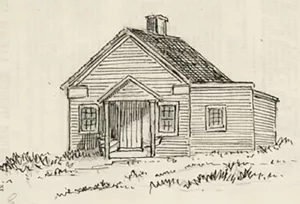
Credit: Image 1852 Robert Sweeny, MNHS
He was deeply interested in the propagation of fish and was appointed the first fish commissioner of the state. In the 1880s he established the first fish hatchery at the mouth of the Lester River in Duluth for Lake Superior’s commercial fishery. As its superintendent, the family relocated to Duluth in 1889 until Sweeny’s death in 1902. He was buried in Oakland Cemetery in St. Paul.
The fishery closed in 1946 and was sold to the University of Minnesota Duluth as its Limnological (fresh water) Research Station. Its surviving four Stick and Shingle Style buildings were listed on the National Register of Historic Places in 1978.
Credit: MNHS
More legacy: Sweeny chronicled/sketched early pioneer life in Minnesota! The Minnesota Historical Society has over 400 of his historic images of early St. Paul. They included early log homes, commercial buildings, geological sites, fur traders and Natives, and plants. He also is credited with Minnesota’s moniker as the “gopher state” from an unsuccessful political cartoon. During the Civil War, 1861-62, he accompanied his brother-in-law, Dr. Stewart to Missouri and Arkansas, as an unpaid hospital steward/pharmacist where he continued to sketch. Recovering from an eye injury, he traveled to Mankato for the execution of 38 Dakota from the uprising. His portraits of ten were created the morning of the hanging December 26, 1862.
Quaker women of Minnesota: Anna Earl Jenks married (governor) Alexander Ramsey in 1844. She brought a large amount of money to the marriage, which Ramsey invested in real estate in Minnesota. Robert Sweeny married Helen Benezet in 1864. Benezets were prominent Quakers, abolitionists and philanthropists in Philadelphia. Robert’s sisters Mary Sweeny married William L. Banning (banker, Banning State Park) in 1850 in Philadelphia, and Catherine Sweeny married Dr. Jacob H. Stewart (doctor, mayor, postmaster, state senator, state surgeon general, US congressman, and state surveyor) in 1857 in St. Paul.
You can find a copy of “The Origin Story of Fort Road/West Seventh Street, the Township/City of Saint Paul, the Territory/State of Minnesota: Glacial Age Forward” at your local library, or order up a copy of your own at fortroadfed.org. Learn more about the book and find Joe’s upcoming conversations about the history of West 7th at josfland.com.



Leave a Reply