Ramsey County officials are advancing an ambitious $320 million economic development strategy aimed at revitalizing downtown St. Paul and strengthening the county’s long-term fiscal outlook, though key questions remain about funding and timing.
The initiative, dubbed “Building Stronger Together,” was formally introduced April 14 as a coordinated effort to reinvest in the county’s urban core while preparing publicly owned land for future private development. Leaders say the plan is both a response to pandemic-era economic shifts and a proactive strategy to address structural budget pressures.
“Building Stronger Together is a $320 million investment that reflects our commitment to economic resilience, housing access and long term fiscal health,” said Board Chair Rafael Ortega.
Downtown revival at the center
A central focus of the plan is downtown St. Paul, which county officials describe as critical to regional economic health but still struggling with reduced office occupancy, declining property values and lower foot traffic.
Community and Economic Development Director Josh Olson said the strategy is designed to “stimulate both private and public investment, with the goal of creating a more vibrant and dynamic and active downtown.”
Approximately $250 million of the proposed investment is directed toward downtown initiatives. These include infrastructure upgrades, housing development, business activation programs and improvements to public spaces designed to make the area more attractive to residents and visitors.
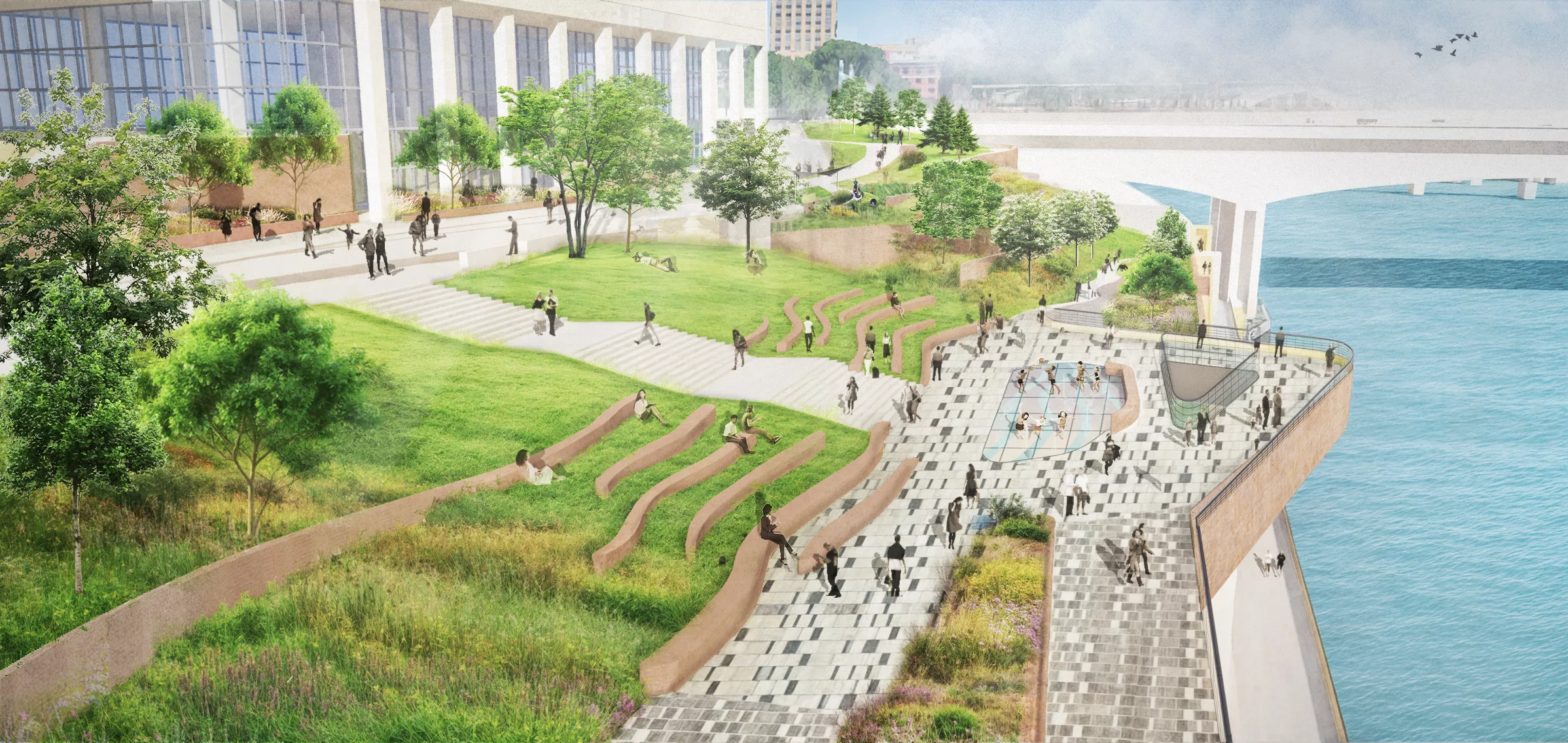
Among the most prominent proposals is the long-envisioned River’s Edge redevelopment site along the Mississippi River. Plans call for transforming the area into a mixed-use district with new housing, commercial activity and expanded park space, reconnecting downtown to the riverfront.
“For us, that’s the public realm,” Ortega said. “The crucial piece for us is to build a park that goes down to the river.”
The county’s push aligns with recent action by the city of St. Paul, which approved a $5 million downtown investment package on March 27. Mayor Kaohly Her emphasized the importance of coordination across governments.
“This moment reflects something important: alignment,” Her said. “City, county and state leaders are not just working alongside each other. We are working with each other toward a shared vision for downtown.”
She said the investment is about bringing more activity into the city’s core, adding, “The investment we are talking about today will help bring more people, more energy and more opportunity into the heart of our city.”
County leaders say these investments are intended to catalyze private development and increase the number of people living downtown—a shift seen as essential to stabilizing the tax base and supporting local businesses.
Together, the city and county initiatives reflect a growing consensus that downtown St. Paul must evolve beyond its traditional office-based economy.
Understanding the $320M ‘Building Stronger Together’ plan
Total proposed investment: $320 million
Downtown St. Paul focus – $250 million
River’s Edge redevelopment (infrastructure, park space, mixed-use development)
Up to $50 million in bonding for mixed-income housing
Public realm improvements (streets, plazas, pedestrian connections)
Business development and activation programs
Countywide development – $70 million
Infrastructure for county-owned sites
Site readiness (utilities, roads, environmental work)
Support for projects such as Rice Creek Commons
Funding sources
Existing county funds and reallocated project dollars
Housing and Redevelopment Authority (HRA) resources
Transportation and infrastructure funding streams
Anticipated state bonding (not yet secured)
Expanding the tax base through land development
While downtown is the centerpiece, the initiative also targets long-term growth across Ramsey County through redevelopment of publicly owned land.
Olson said Ramsey County is uniquely positioned to drive growth as a major landowner.
“The county owns currently hundreds of acres of vacant, underutilized land across the county that is truly ripe for redevelopment and ready for redevelopment,” he said.
About $70 million is allocated to prepare and market county-owned properties for development. This includes infrastructure investments—such as roads, utilities and site preparation—intended to make parcels more attractive to private developers.
County officials noted that Ramsey County is fully developed, with limited opportunities for large-scale new construction. As a result, converting underutilized land into productive uses is seen as one of the few viable paths to expanding the tax base.
Projects like Rice Creek Commons, a major redevelopment site on the former Twin Cities Army Ammunition Plant, are expected to benefit from this approach.
Officials argue that bringing more land onto the tax rolls will help offset financial pressures driven by rising service costs and a significant share of tax-exempt property. Roughly 14% of property in the county does not generate property tax revenue, according to county data.
Financial pressures driving urgency
County leaders framed the initiative as a response to mounting financial pressures, including rising service costs, limited land availability and a heavy reliance on property taxes.
County Manager Ling Becker said those pressures are unsustainable without expanding the tax base.
“We’re facing real and compounding challenges—a downtown still rebuilding momentum, a constrained tax base, rising service demands,” Becker said. “And all of this puts added pressure on our property taxpayers. And that is unsustainable.”
“Reducing this property burden is our number one priority at the County,” she added.
County leaders point to increasing demand for services, including public health and human services, alongside rising costs that have increasingly shifted from federal and state governments to local jurisdictions.
At the same time, the value of commercial office space—traditionally a major contributor to property tax revenue—has declined in many downtowns, including St. Paul.
Without intervention, officials warn, these trends could lead to continued pressure on residential property taxes.
“At the end of the day, we cannot tax our community to a point that they cannot live here,” Becker said.
No levy increase—but questions remain
Despite unanimous support from county commissioners, the plan faces a number of hurdles.
Officials said the $320 million plan will not require an increase in the county’s property tax levy. Instead, it relies on existing resources, bonding and anticipated external funding.
“This strategy does not increase the property tax levy,” Olson said. “Instead, it comes from dedicated resources and through strategic bonding.”
However, several major components depend on funding that is not yet secured.
The county is seeking state bonding dollars, including about $20 million tied to River’s Edge. While lawmakers expressed support, approval is not guaranteed in a divided Legislature.
State Rep. María Isa Pérez-Vega said she is continuing to push for funding.
“We’re going to keep fighting for it,” Pérez-Vega said. “I’m confident that we’re going to get something through the finish line.”
That uncertainty could affect both the scope and timing of key projects.
Still, Ortega made clear that the broader initiative is not entirely dependent on state funding.
“Even if the request for $20 million at the legislature doesn’t happen this year, it does not stop us from moving forward,” he said.
In addition, some aspects of the River’s Edge redevelopment require agreements with railroad companies that control adjacent land and infrastructure. County officials acknowledged that negotiations are ongoing and that no final agreements are in place.
County officials said discussions are ongoing but acknowledged that progress will take time.
One of the most significant unanswered questions is timing.
Officials did not provide a clear timeline for when major projects—particularly River’s Edge—would begin or be completed.
Ortega acknowledged the uncertainty when asked about construction timing.
“Standing still, the answer is, it’ll never be done,” he said. “We’re going to move forward.”
Becker said the decision to launch the plan now reflects urgency rather than waiting for all details to be finalized.
“At some point, we have to have this moment,” she said. “We are not satisfied with a downtown and a community that’s going to be stagnant.”
While some elements—such as planning work and community engagement—are already underway, officials did not provide specific dates for when major construction projects would begin or be completed.
Instead, leaders described the initiative as a flexible, multi-year strategy that will evolve as funding becomes available and partnerships are secured.
The county plans to host additional workshops and stakeholder meetings in the coming months to refine project details and gather public input.
Still, the lack of a defined timeline raises questions about how quickly residents and businesses might see tangible results.
A catalyst for broader change
Despite the uncertainties, county leaders repeatedly framed the initiative as a necessary step to reverse economic stagnation and position St. Paul for long-term growth.
“This is the moment to act,” Ortega said. “Ramsey County [will] be a catalyst to start bringing life back to our city.”
Mayor Her echoed that sentiment, tying the effort to broader regional success.
“A strong downtown St. Paul is essential to a strong region,” she said.
For Ramsey County, the strategy represents both a significant financial commitment and a calculated risk—one that hinges on partnerships, market conditions and political support.
And for downtown St. Paul, the coming years will determine whether “Building Stronger Together” can translate vision into reality—or whether funding gaps and logistical challenges will slow its momentum.
As Becker put it, “No one is coming to solve these challenges for us. This is our moment.”
Watch the Ramsey County Board Presentation on the Initiative
Watch the Press Conference
Additional Resources
Learn more about the Initiative: ramseycountymn.gov/your-government/projects-initiatives/building-stronger-together.
Read more about the Rivers edge project: ramseycountymn.gov/your-government/projects-initiatives/economic-development-initiatives/riversedge
Read more about the City’s Downtown Development Fund: stpaul.gov/departments/planning-and-economic-development/economic-development/downtown-vitality-fund




Leave a Reply