
The land of skyblue waters, Minnesota, did not provide clean drinking water for its growing population. In the West End, the glacial landscape created a series of river terraces with various small streams that drained its bluff-line wetlands. This urbanized watershed was in a pristine state before the industrial pressures of the 19th-century. During Minnesota’s Territorial Period (1849-1858), rainfall or snowmelt moved over and through the ground, picking up pollutants from widespread, non-specific sources. Rivers were treated as convenient conduits for waste—human, agricultural, industrial and feral that introduced pollutants. Eventually commercial and residential infill would bury the streams into an underground storm sewer network—to the river.
The later 1800s led to severe water pollution that drove disease transmission, particularly the spread of waterborne diseases like typhoid, cholera and hepatitis.
The Town Pump
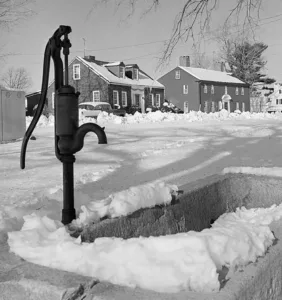
Before indoor plumbing, a “primitive” water source for a community was the town pump. In the summer of 1849 St. Paul’s population grew to over a thousand and got its first post office (Henry Jackson, postmaster), first brick yard, first school board—and its first town pump.
The Minnesota Pioneer reported July 5,1849 that “Within the present week the citizens of St. Paul have erected in the lower square a pump. Of course nothing could be more desirable, or to the city more appropriate. For what is a town without a ‘town pump?’ It is ‘a church without a bishop!’ How will a stranger know when he arrives in our steepleless city unless it has the centre marked with a pump! A town pump is useful on numerous accounts. It is the centre exchange, where merchants and financiers do the fiats of commerce. It is the place for placards of advertisement; a reference for details of information upon all doubtful questions—as when we say, ‘inquire of the town pump.’ It might do for the stand of a temperance lecturer. It might answer as a whipping post for rogues of low degree; and might perhaps subserve a patriotic purpose as a ducking engine with which to quench the heat of over zealous office-seekers.”
August 29, 1850 reported an ordinance: “That here after it shall be unlawful for any person or persons to water horses or cattle of any kind at the town pump, under a penalty of five dollars for each offence to be collected as other penalties to the town.”
The City Water System
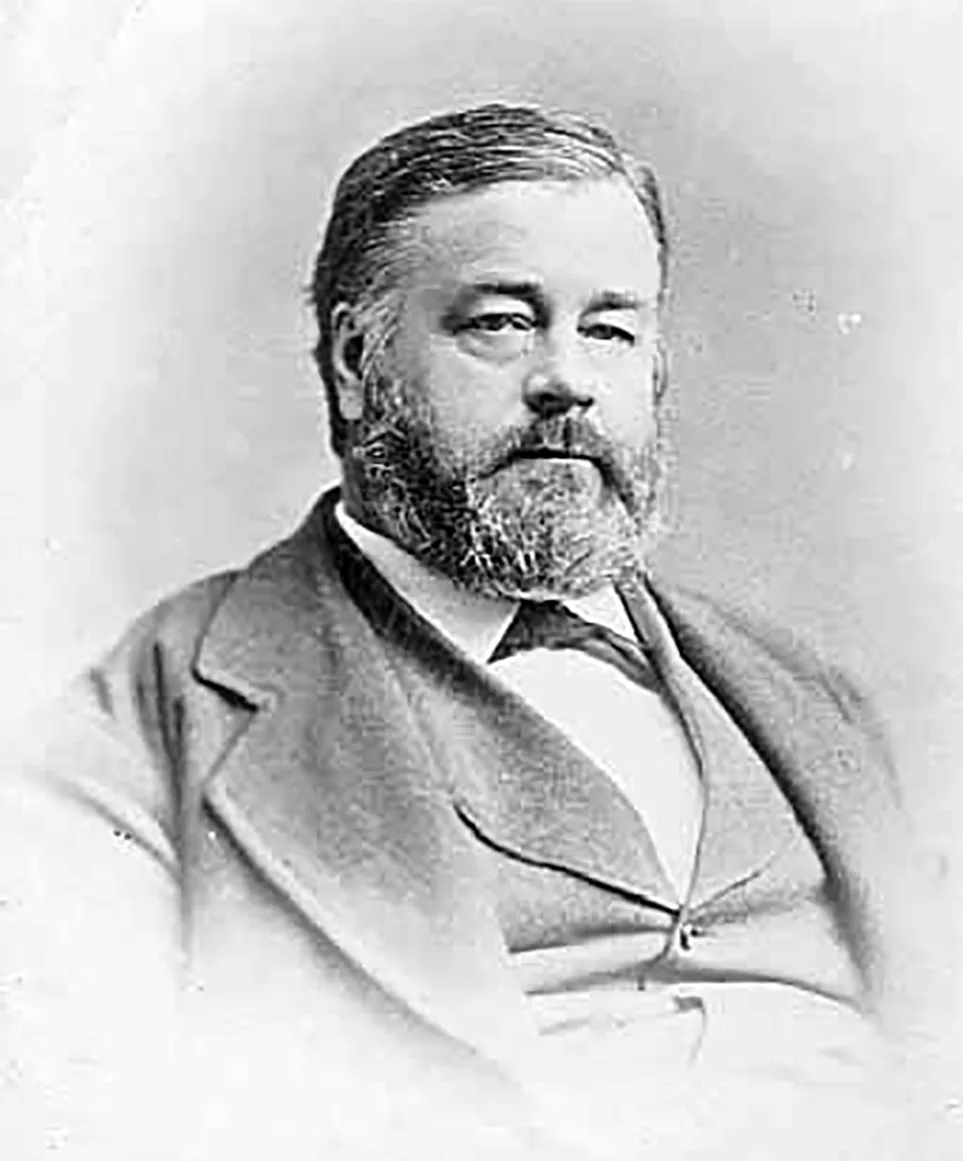
But a town pump was not the answer to a growing city. C.D. (Charles Duncan, 1831-1902) Gilfillan was born one year after his family emigrated to the US from Bannockburn, Scotland. His brother, Judge James Gilfillan (1829-1894) would become a respected Minnesota Supreme Court Justice.
They were orphaned in their teens. C.D. continued his education in New York culminating in law in 1853. In 1857 the brothers began a law partnership in Minnesota. They accumulated wealth when the government redirected Native payouts to white survivors of the Dakota uprising.
CD’s legacy lay in facilitating and providing St. Paul with reliable, high-quality drinking water. In 1851, editor James M. Goodhue of the Minnesota Pioneer noted that wells were few, and water, when available, cost ten cents a barrel hauled to one’s door. In 1856 the territorial legislature chartered a private water company followed by a survey for a source and multiple efforts at financing. In 1865 CD was named president of the St. Paul Water Company that planned and constructed its waterworks. By 1869, water began to flow from Lake Phalen but water distribution was limited, and residents still relied on private wells or water vendors. In the later 1870s Gilfillan purchased land in northern Ramsey County and its lakes to guarantee water supply to the system, including the Pleasant/Vadnais Lake watershed. All stock, 2,500 shares, in the water company was held by the Gilfillan brothers (only 100 by James). On August 10, 1882 the city purchased all shares for a publicly owned company and assumed the company’s indebtedness. In 1925 the Mississippi River was integrated into the system through a 60-inch conduit from Fridley to Charley Lake and the Vadnais Lake system.
C.D.’s first marriage in 1859 to Emma Waage ended with her death and he married her sister Fannie (1841-1918) in 1865 and had four children. In the 1880s C.D. quietly bought significant acreage that eventually became North Oaks, then sold them to his friend and railroad magnate J.J. Hill. In 1882 he built the Gilfillan Block, Fourth and Jackson Streets and was vice-president of the First National Bank.
In 1882 he retired to Redwood Falls. He accumulated 10,000 acres for his home, office, grain elevator, stockyards and tenant houses. A railroad spur from his home delivered stock to Chicago as well as his private car to St. Paul. The family made annual trips to Europe where their children were educated. C.D. thus was the founder of the St. Paul city water works, became a member of the Minnesota Valley and State historical societies, was co-founder of the anti-slavery Republican Party, and an innovative agriculturalist and cattle breeder in Redwood County, Minnesota. He died in 1902; the funeral was at 237 Exchange Street, home of Mrs. James Gilfillan, burial in Oakland Cemetery.
Partially adapted from Merrill E. Jarcow “Like Father, Like Son: The Gilfillan Story. 1986 RCHS.
You can find a copy of “The Origin Story of Fort Road/West Seventh Street, the Township/City of Saint Paul, the Territory/State of Minnesota: Glacial Age Forward” at your local library, or order up a copy of your own at fortroadfed.org. Learn more about the book and find Joe’s upcoming conversations about the history of West 7th at josfland.com.






Leave a Reply