
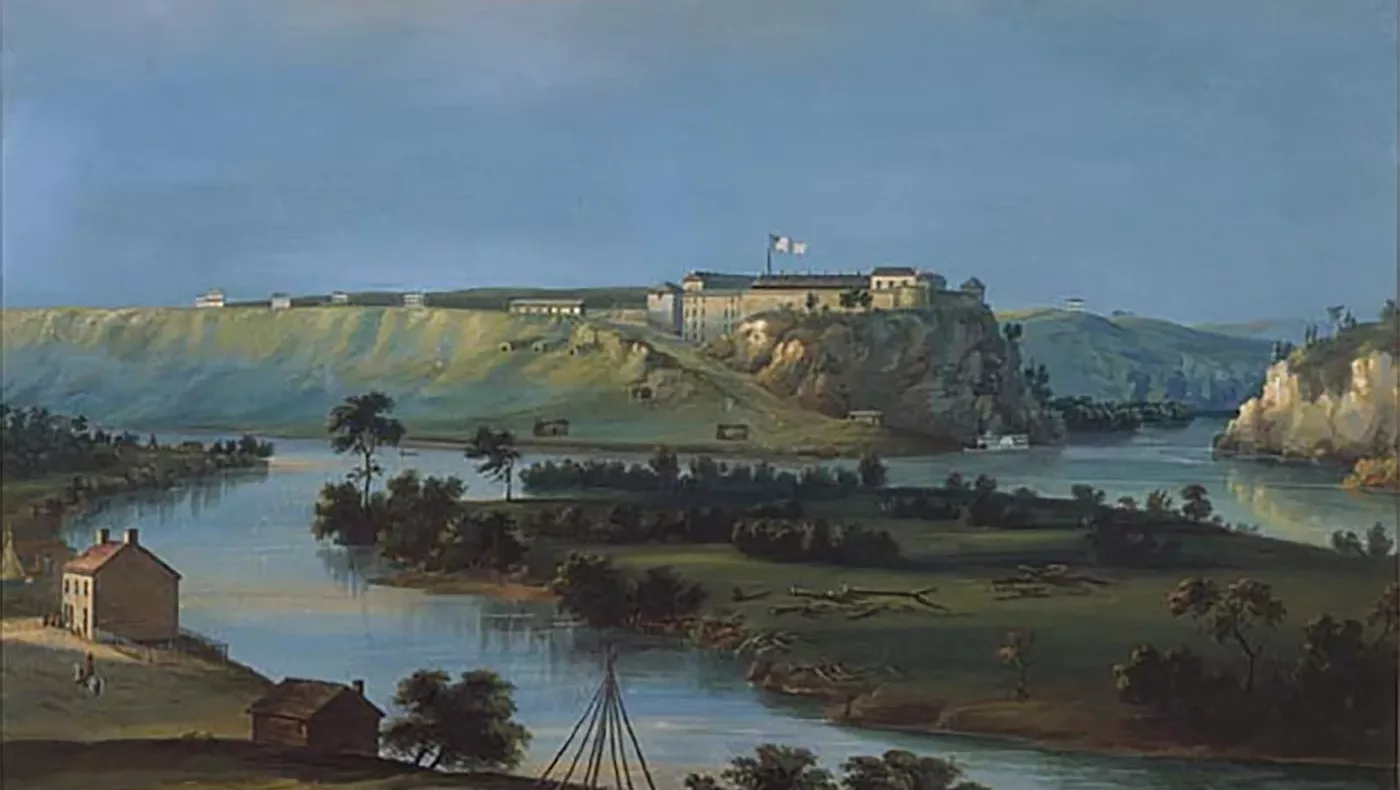
While Fort Snelling has been around a couple hundred years, the Dakota have called Bdote home for eight thousand. Bdote is the confluence of the Mississippi and Minnesota (St. Peter) Rivers and sacred to Native tribes, particularly the Dakota.
In 1783, the area between the Atlantic coast and the eastern bank of Mississippi River was ceded by Great Britain to the United States. In 1803 the French sold the Louisiana Purchase to the United States; both banks of the Mississippi River were now controlled by the United States. The Americans then needed to impoverish the Dakota to assert control over their land—which they did.
In 1819-20 Lt. Colonel Henry Leavenworth (Connecticut, 1783-1834) wintered at Bdote when he negotiated an agreement with the Dakota at Mni Owe Sni-Coldwater Spring for the construction of a fort to restrict British fur traders, mediate between Dakota and Ojibwe tribes and restrict American settlement until allowed by Native treaties.
In 1820, Colonel Josiah Snelling (Boston, 1782 -1828) succeeded Leavenworth. A diamond-shaped fort of local limestone was built. With no formal architect Snelling and Lieutenant Robert McCabe, (Pennsylvania, 1790-1845), the fort’s engineer, collaborated on the overall design, using the bluffs to guide its diamond shape. Pvt. James Delaney (Irish,1823-1890), a master stone cutter and Pvt. William Goddard (England, 1789-) master builder and stone mason were responsible for the successful completion of the construction. All the manpower came from the troops: carpenters, lime burners, quarriers, masons, bricklayers, stonemasons. Liquor was a common fuel against the rigors of frontier life: two gills/half pint of whisky per man through the day, double for men at headquarters.
Snelling suffered from dysentery, addiction to opium and brandy and was quite abusive to his men until his departure in 1827. He was subject to accusations of poor military discipline and embezzlement. He was recalled to Washington, D.C. but died in 1828 before a court marshal.
From 1830-1832 and 1841-48 Seth Eastman (1808-1878) was assigned to Fort Snelling as military commander. He learned the Dakota language, married Wakháŋ Inážiŋ Wiŋ. After the birth of their baby girl, he declared the marriage over, returned to West Point in 1832, and married Mary Henderson in 1835; they had five children. During the later command Eastman became known for his realistic oil paintings, drawings and watercolors of the everyday life around Fort Snelling of Dakota and Ojibwe people. Mary authored and published “Dahcotah; or, Life and Legends of the Sioux Around Fort Snelling” based on her experiences.
It was common, not only for early French fur traders, but also American officials to take Native wives, and then move on to white ones. Blended family names dot Minnesota history: Sibley, Woodbury, Kittson, Schoolcraft, Rolette, Taliaferro, Faribault, Campbell, Lamont, etc. Their mixed-blood progeny bloodlines continue to this day.
1837-39
The fort’s community included soldiers, traders, missionaries, settlers, visitors (tourists!) and lumbermen as well as the Dakota and Ojibwe. The latter camped apart from the Dakota at Coldwater Spring when they ventured south to the fort.
The military community included officers and enlisted men, half American-born, a third Irish. Many were employed in trades for building and maintaining the fort; there were 48 occupations of the soldiers. Some had wives serving as laundresses. Officers came with servants and/or slaves. By the end of January 1838 there were 80 men, 20 per company reduced to half at mid-year, bolstered by 145 recruits in June. A chaplain began work in August.
Connected to the fort was the Indian (St. Peter’s) Agency headed by Major Lawrence Taliaferro with a cadre of 18 employees who mediated primarily between the Dakota and Ojibwe, but also with settlers and other groups in carrying out treaty provisions. The populations were quite fluid in terms of numbers owing to settlement, seasonal demands and geographical interaction.
White civilian servants at the fort were often related to the soldiers. Duties ranged from husbandry to household/laundry type tasks. In addition there were a dozen or so slaves. Officers received a government stipend for slaves; pay for civilian servants was through the paymaster.
Major Joseph Plympton (1787-1860) became the post commander in August 1837 and focused on surveying and defining the fort’s land boundaries of 100,000 acres, all land between the St. Croix and Mississippi Rivers. He evicted settlers to the area of Fountain Cave, then further evicted them to the Upper Landing.
With the first eviction in 1838 civilian settlers, mixed blood and white, around Fort Snelling began an exodus to Le Clere’s (Point) downriver via Fountain Cave. The settlement would become Pig’s Eye, then the Township of St. Paul.
To be continued.
You can find a copy of “The Origin Story of Fort Road/West Seventh Street, the Township/City of Saint Paul, the Territory/State of Minnesota: Glacial Age Forward” at your local library, or order up a copy of your own at fortroadfed.org. Learn more about the book and find Joe’s upcoming conversations about the history of West 7th at josfland.com.




Leave a Reply