When green-clad marchers step into downtown St. Paul this March, they will be continuing a tradition that stretches back more than a century — and a modern parade that has become a defining civic celebration.
The city will mark the 60th annual downtown St. Patrick’s Day Parade in 2026, an event organizers say reflects generations of Irish heritage, volunteerism and community pride.
Deep Irish roots
St. Paul’s enthusiasm for St. Patrick’s Day predates the current parade by well over a century. Minnesota’s first St. Patrick’s Day parade was held in St. Paul in 1851, an impromptu celebration featuring about 300 participants, speeches and a ceremonial salute.
Irish influence in the city ran deep even then. Downtown’s earliest settlers included Irish soldiers from Fort Snelling, and by the 1880s a large Irish community had formed in the Connemara Patch neighborhood on the East Side. Irish Americans also held significant political influence; between 1932 and 1972, nine out of 10 St. Paul mayors were of Irish descent, Visit Saint Paul notes.
Early parades often carried a temperance message. The Irish Catholic Temperance Society led many of the first marches, and in 1856 the Benevolent Society of Erin hosted a St. Patrick’s gathering featuring toasts of cold water instead of alcohol.
The celebration peaked in 1901 when the Ancient Order of Hibernians coordinated special railroad rates that helped draw about 4,000 parade participants. But the following year, Archbishop John Ireland halted festivities he believed had become excessive, and large-scale parades faded for decades.
A grassroots revival
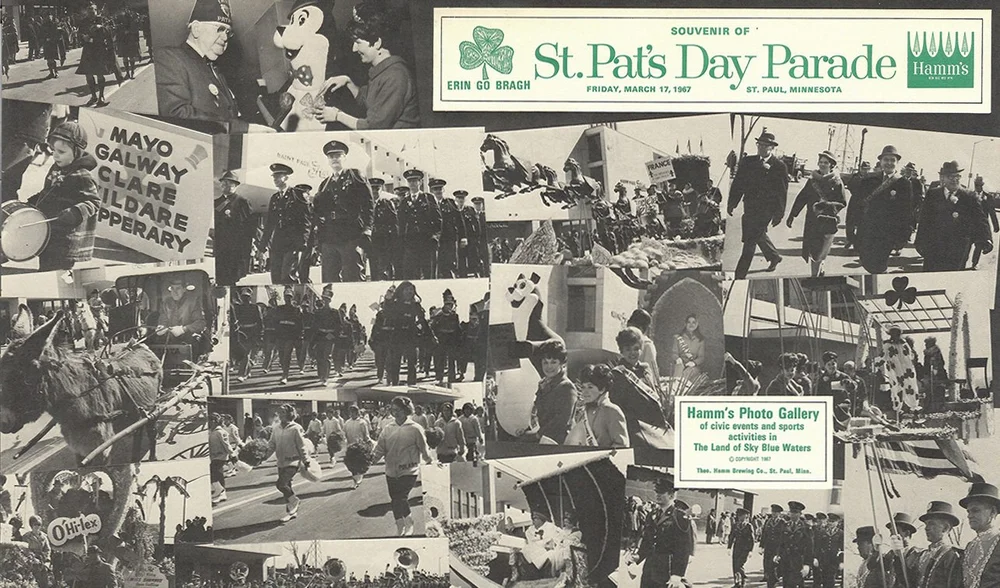
The modern era began in 1967 with a conversation at Gallivan’s restaurant and bar.
“It was a bitter cold day during the Winter Carnival,” Bob Gallivan later recalled to the St. Patrick’s Association. Looking for a way to celebrate local Irish culture, he suggested starting a parade “before we get too old.”
The idea quickly gained traction. Judge Edward Devitt, a regular parade marcher, joined the first organizing committee, noting St. Paul was a “natural center” for such a celebration because of its large Irish population.
That first modern parade came together in just two months but drew crowds six people deep along sidewalks. Led by Mayor Thomas Byrne carrying a shillelagh, marchers stepped off from the then-Hilton hotel at noon and reached the St. Paul Hotel about 40 minutes later.
From the start, organizers emphasized a family-friendly focus. Stewart Loper of the St. Patrick’s Association described the event as “a baby buggy parade,” reflecting the goal of keeping participation centered on families and children. Motorized vehicles have traditionally been kept to a minimum, a policy that continues today.
Traditions take hold
Several customs established in 1967 remain central to today’s celebration.
The crowning of Ms. Shamrock — first awarded to Agnes Sullivan — continues as one of the parade’s signature honors. The title of Mr. Pat, first given to William J. Hickey, recognizes a man of Irish descent who has contributed significantly to St. Paul’s civic life.
Another enduring image is the stripe of emerald paint laid down the center of the parade route. Fundraising traditions also persist, including the annual “button blitz” conducted by the Miss Shamrocks and Blarney Brothers to support parade costs and charitable efforts.
Over time, the event has grown dramatically. Attendance reached about 100,000 spectators in 2007, according to historical summaries, cementing the parade’s place among the city’s largest annual gatherings.
A living community celebration
Today’s parade, organized by the St. Patrick’s Association, continues to emphasize the same core values outlined at its founding: honoring Irish heritage while keeping the event welcoming and community-focused.
The celebration also reflects St. Paul’s broader Irish cultural landscape. The city hosts the large Irish Fair of Minnesota each summer, maintains numerous Irish pubs and businesses, and supports institutions such as the Celtic Junction Arts Center that promote Irish music, dance and history.
Organizers say that continuity — balancing tradition with community participation — is why the parade has endured.
“As we approach the 60th Annual St. Patrick’s Day Parade in 2026, we honor the people, organizations and traditions that have shaped this celebration and kept it marching strong for nearly six decades,” the St. Patrick’s Association said of its history.
From a small gathering of 300 marchers in 1851 to a modern spectacle filling downtown streets with music and green each March, St. Paul’s St. Patrick’s Day parade remains both a tribute to the city’s Irish past and a living expression of community pride.
Celebrate St. Patrick’s Day in 2026
Find more about this year’s St. Patrick’s Day celebration in St. Paul in our preview of their year’s festivities.




Leave a Reply