
In 1680 Franciscan Louis Hennepin, a Catholic missionary, began exploring Minnesota along with French and métis fur traders. In 1727 two Jesuits, Michael Guignas and Nicholas De Gonnor, built the first church in Minnesota, a log cabin Catholic mission at Fort Beauharnois overlooking Lake Pepin. It was dedicated to St. Michael the Archangel and abandoned in 1756. In 1891 Ursuline nuns built a convent and school at the location, then the Villa Maria Education & Spirituality Center in 1970. It closed in 2016 and is now a boutique hotel/event center.
Protestant missionaries began their missions in 1834 when Samuel and Gideon Pond and Dr. Thomas S. Williamson established missions at Bde Maka Ska, Lac qui Parle, and Red Wing where they also encouraged Native sedentary farming. The Pond brothers assembled a Dakota language alphabet and the first Dakota-English dictionary. With the expulsion of the Dakota in 1862 to the Dakota Territory, missionaries relocated with them.
Credit: Photo Courtesy of MNHS
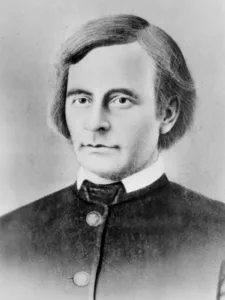
In 1829 Bishop Mathias Loras, of Dubuque, visited Fort Snelling, then returned to France to recruit priests for Minnesota. Joseph Cretin, A. Pelamourges, Lucien Galtier and Augustine Ravoux arrived in Dubuque April 19, 1839. In 1839 Loras, arrived in Mendota and Fort Snelling with Father Pelamourgues. They baptized 56 and married eight of the 185 Catholics. In 1840 Father Lucien Galtier followed and organized a parish (St. Peter’s) in Mendota at Bdote, the confluence of the Minnesota and Mississippi rivers. Galtier, who “had the face of a Caesar and the heart of a Madonna”, served for four years.
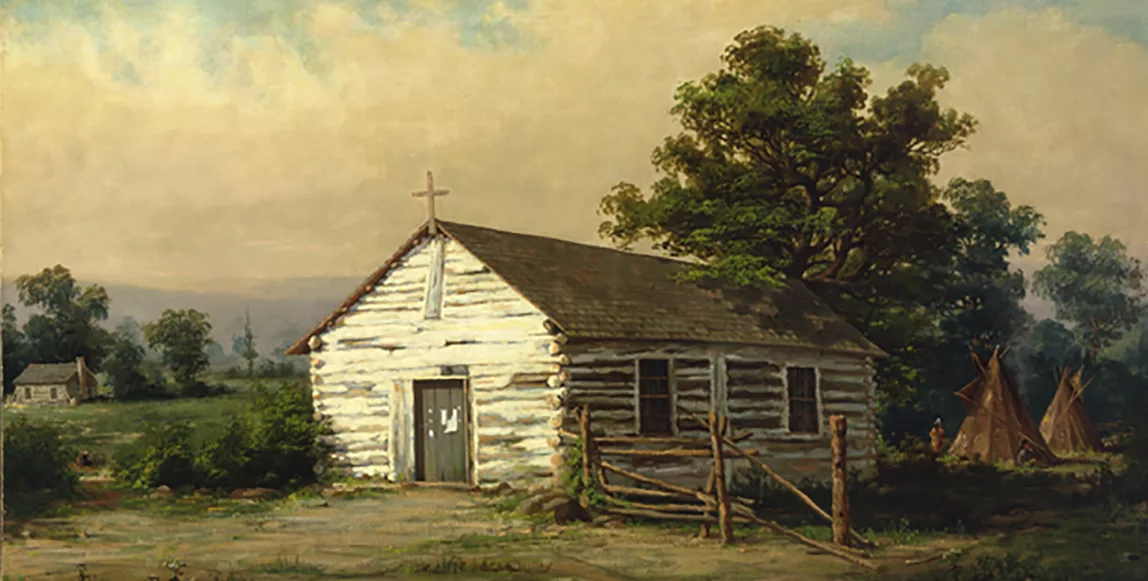
In 1838 and 1841, with the expulsion of settlers from the Fort Snelling Reservation, two French-speaking communities developed down river from Fountain Cave and at Point Leclaire. Galtier visited the settlements to seek a site for a church. Two options were rejected: Lowertown/Pointe Leclaire (subject to flooding) and Dayton’s Bluff/Mounds Park (elevated and inaccessible). In 1841 he chose a point mid-way between the Upper and Lower Landings on the sandstone bluff high above the river. The acre of land, donated by Vital and Benjamin Gervais, was thinly covered with groves of red and white oak with a tamarack swamp at back. The tamarack was logged for the rough-hewn chapel’s rafters. Bark-covered slabs for the roof were brought from a Stillwater mill owner. A simple cross crowned the roof. The chapel was about twenty-five feet long, eighteen wide and ten high. A single window graced each side; it faced the river on its bluff. It was completed in a few days by eight workers: Joseph Labissonière was general superintendent with builders Isaac Labissionière, Pierre Gervais (the elder), Pierre Gervais (the second), Pierre and Charles Bottinneau, Francois Morin, and Vital Guerin. Their names are now commemorated on the stone memorial on its location in Downtown St. Paul.
Galtier: “The church was thus dedicated to St. Paul, and I expressed a wish that the settlement should be known by no other name.” When Vital and Adele Guerin were married, the official bans listed their residence as St. Paul. By 1854 residents were so numerous it was necessary to hold three services on Sunday—French, German, and English. Each group heard a sermon in its own language. When Henry Jackson’s grocery opened in Lowertown, steamboats began to stop at the “St. Paul Landing”. The church was deconstructed in 1855 due to development pressures of the surrounding midtown area.
After four years Galtier was transferred to Iowa but left shortly after in disagreement with Bishop Loras in Dubuque. In 1847 he joined the Diocese of Milwaukee and served at St. Gabriel’s Parish in Prairie du Chien, Wisconsin, He remained there until his death in 1866.
Adapted from The Tales and Times of Isaac Labissoniere, A Minnesota 19th Century Pioneer, by Mark Labine, 2025.



Leave a Reply