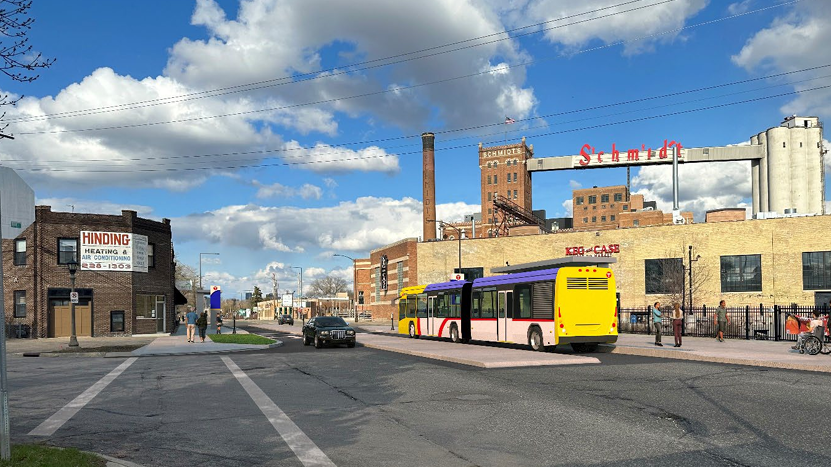
After decades of planning, false starts and shifting priorities, a new vision for transit along West 7th Street is beginning to take shape — this time as bus rapid transit.
The Metropolitan Council formally approved the METRO J Line, designating the West 7th corridor as one of the region’s next arterial bus rapid transit (BRT) projects, on March 11. The line is expected to connect downtown St. Paul, Union Depot, Minneapolis-St. Paul International Airport and the Mall of America, with service anticipated between 2030 and 2035.
The decision marks a significant milestone for a corridor that has seen more than two decades of study and repeated setbacks, most recently with the collapse of the long-planned Riverview Corridor and the scaling back of the city-led “New West 7th Corridor” concept.
“This is a great milestone,” Metropolitan Council Chair Robin Hutcheson said during the March 11 meeting, emphasizing the years of technical analysis, committee review and public engagement behind the vote. “These bus rapid transit lines have gone through years of staff analysis and vetting.”
A pivot after years of uncertainty
The J Line represents a strategic pivot after the dissolution of the Riverview Corridor project in 2024, which had envisioned a modern streetcar or light rail line along West 7th. First studied in 1998, Riverview consumed more than $11 million in planning funds but ultimately failed amid rising costs, shifting priorities and a lack of consensus among funding partners.
Following that collapse, the City of St. Paul attempted to revive the effort through the “New West 7th Corridor” plan, a multimodal concept that paired street reconstruction with enhanced transit. But by fall 2025, that effort had also stalled when partners were unable to agree on a funding strategy.
Metropolitan Council Member Deb Barber said the inclusion of West 7th in the arterial BRT plan required a quick pivot by staff.
“Originally it had been Riverview Corridor, then it transferred over to being the West 7th concept plan,” Barber said. “When all of those things were not coming together, the staff really came together and came up with a way to work in West 7th into the overall strategy.”
The result is a scaled but more feasible approach: arterial BRT, which typically includes frequent service, enhanced stations, off-board fare payment and transit signal priority — improvements designed to deliver faster, more reliable bus service without the cost of rail.
Choosing from 17 corridors
The J Line emerged from a broader planning process led by Metro Transit in 2025 and early 2026. The agency began with 17 candidate corridors before narrowing the field through a four-step process that included screening, technical evaluation and prioritization.
According to Metro Transit, the West 7th corridor scored highly based on ridership potential, equity considerations and its fit within the growing METRO network. Roughly 35% to 40% of residents within a 10-minute walk of the corridor identify as people of color, and about 28% live in poverty — factors that weighed heavily in the evaluation.
The corridor was also added relatively late in the process after the collapse of the city’s earlier plan, underscoring both its importance and the urgency to identify a viable path forward.
The Metropolitan Council’s approval does not include funding but formally places the J Line into the region’s arterial BRT program, allowing planning, environmental review and coordination with roadway projects to move forward.
A “generational investment” in the corridor
The transit project is unfolding alongside a broader effort to reconstruct West 7th Street itself. In January, the City of St. Paul, Minnesota Department of Transportation and Ramsey County announced what they described as a “generational investment” in the corridor.
Plans include rebuilding and repaving large segments of the roadway, updating utilities, improving pedestrian crossings and addressing long-standing safety concerns. While initial funding is in place for planning and design, officials say additional state and federal dollars will be needed to complete the work.
The timing of the roadway project — expected to begin construction later this decade — could be critical to the success of the J Line, as arterial BRT projects often rely on coordinated street design to incorporate stations and transit priority features.
Lingering frustration, cautious optimism
For many residents and business owners along West 7th, the announcement brings cautious optimism after years of delays that have left both infrastructure and redevelopment plans in limbo.
Previous proposals repeatedly pushed back basic maintenance, including a long-delayed mill-and-overlay project now expected to begin around 2028. Community members have voiced frustration that the lack of a clear plan has hindered investment and made the corridor less safe for pedestrians and transit riders.
“The roadway doesn’t care if the agencies can’t figure out a vision,” a Minnesota Department of Transportation official said during a 2025 community meeting, highlighting the deteriorating condition of the street.
At the same time, skepticism remains about whether the latest plan will deliver meaningful change or face the same challenges as its predecessors.
Funding remains the biggest hurdle
The largest unresolved question is funding.
The collapse of the Riverview Corridor was largely driven by cost, with estimates reaching into the billions. That challenge resurfaced in 2025 when the Ramsey County Board of Commissioners reallocated nearly $1 billion in transportation sales tax revenue — much of it previously earmarked for Riverview — to other projects, leaving West 7th without a dedicated funding source.
City leaders are now seeking renewed support through their 2026 legislative agenda, which calls for multi-year state investment in the West 7th corridor. The proposal positions the project as critical to economic development, transit access and overall corridor revitalization.
Without significant state and federal funding, however, both the roadway reconstruction and the J Line could face further delays or scaled-back ambitions.
What comes next
With the corridor now officially designated as the J Line, Metro Transit is expected to begin detailed planning and community engagement later this year. That process will refine station locations, service plans and design elements, while coordinating closely with roadway reconstruction efforts.
If funding can be secured and planning stays on schedule, construction could begin in the early 2030s, with service launching sometime between 2030 and 2035.
For a corridor that has spent decades in planning limbo, the timeline may still feel distant. But for the first time in years, officials say there is a clear — if incremental — path forward.
“This is a very important line for the East Metro,” Barber said. “And I’m really, really happy and proud of all the work they did.”
Whether the J Line ultimately delivers on long-promised improvements for West 7th may depend on something that has eluded the corridor for years: sustained funding, coordinated leadership and the ability of multiple agencies to finally move in the same direction.
Read more: metrotransit.org/arterial-brt-plan.



Leave a Reply